Showing posts with label Video Games. Show all posts

Monday, September 26, 2022

The NeverhoOd Chronicles (Part Two) - Return to The Neverhood

Return to The Neverhood's cover art
Released in 2012 by Stunt Records and Stunt Grafx, respectively, Return to The Neverhood - this time written by not by series creator Doug TenNapel, but instead in-house Neverhood Inc. musician, Terry S. Taylor - offers an experimental, artistic, and pridefully pretentious take on the Neverhood's classic bag of tricks; with Christian theming and Play-Doh imagery to the nines, complete with beautiful new art by the aforementioned TenNapel.

However, rather than a point-and-click, a side-scroller, a laser battle, or a failed reboot, Return to The Neverhood is perhaps best described by it's tagline, "a musical fairy tale"; a brand new Neverhood inspired narrative paired with an album's worth of inky, slick, mud-covered tunes. A mixed-media daze of clay cowboys and rusting robots, showing only at the mind's eye.

As a young fan, Return to The Neverhood trudged to life at just the perfect time; I had only discovered the original series the year prior, and as far as I could tell, I was the last living evidence of a Neverhood fanbase. Then - what do you know - out of thin air, radio silence, and a third descriptive phrase, The Neverhood was back! I pre-ordered a physical copy - complete with 19 track CD, 36 page graphic novel, and beautiful thin-plastic slipcase - and, later than sooner, thanks to the horrors of media mail shipping, plunged into the hauntingly abstract tale of faith, fourth walls, and surfin'.


The old man ponders an abandoned sculpture
A bearded, heavy-footed old man - modeled lovingly after narrator, Terry S. Taylor, who opens the story with a self-aware introduction to this, his latest dream - wanders down a muddy, wooded path; mumbling to himself as he stumbles upon an abandoned sculpture; distant, yet familiar memories seeming to  pass him by as he ponders it's familiarity.

Entranced, the old man joyfully begins to further the forgotten sculpture. As the sun began to set, the disheveled sculpture grew to a bustling, beautiful world; dotted with buildings, animals, landscapes, and more - as the old man began his crowning achievements; Clay-Guy, and Mud-Gal - bringing life to the mud-clay world.

Clay-Guy awakens

Lord Lurker
Nearby, a half-mechanical, half-clay being, Lord Lurker, watches in hot silence; filled with sickened rage as he plots against the joyous creatures invading the world he thought was his alone.

As further clay residents are created, the people entitle their world The Neverhood; celebrating as the old man - or, as he comes to be known, the sculptor - offers two commandments via letter; To stay within the Neverhood; as they, themselves, were mere clay; and to only consume foods of their own growth; as any others would inflict them with a terrible illness. The people celebrate, and happily carry on.
 
As Clay-Guy and Mud-Gal spent their days falling deeply in love, many Neverhood residents inevitably found themselves drawn to the dark Lord Lurker - promised a life of further pleasures, only to be arrested and enslaved by the cyborg upon arrival to his compound. Determined to capture the entire population of the Neverhood, a large apple  - of Lurker's creation - is left just outside The Neverhood; only to be discovered by Clay-Guy and Mud-Gal, who, in a moment of weakness, immediately mow down the oddly enticing fruit.

As forewarned by the sculptor, the couple begin to deform and dilapidate; Clay-Guy's soft limbs melting to exposed metal armature, as Mud-Gal sprouts a bulbous hunch. 
The lovers
 
Nevertheless, the couple remain deeply embraced in love; eventually regaining some of their features as they inevitably age, easing in to the world around them all but completely corrupted by the influence of Lord Lurker.
 
Soon, a sudden earthquake tears a massive tidal wave across the Neverhood - drowning many of it's residents. As Mud-Gal sits pretty in a high-rise tower, an increasingly cocky and self-centered Clay-Guy - surreptitiously discovering a piece of wood with which he fashions a makeshift surfboard -  narrowly escapes the flood; thanking only himself, with no regard for the sculptor, who, as is revealed, had placed it there.
 
Clay-Guy surfs the tsunami

The narrative briefly halts as the omnipresent Taylor, recalling his dream, peers into himself; apologizing for the somewhat incoherently remembered series of events thus far, as he wistfully mulls upon the world around him. A tall oak catches his gaze; the morning sun beginning to break as the looming, shadowed branches turn to a golden crown of leaves. He reflects upon the futility of fear, having dreaded the tree's foreboding silhouette in the dark of the night - only to see, as the day came, its everlasting, permanent beauty. Overall, he remains pretty confused.

Back in The Neverhood, another apocalyptic event rocks the clay world; a powerful wind thrusting it's way through the vast city; countless lost to the destructive rush of air, sent flying into the sky. Evading the disaster, Clay-Guy and Mud-Gal develop an odd affliction; spewing fire should they as much as open their mouths, let alone scream - inevitably creating a dense wall of fire as they puke flames into thick hurricane around them. Carried by the wind, the wall of flame overtakes Lord Lurker's compound; freeing the enslaved, and destroying Lurker's villainy; yet, ultimately, engulfing the Neverhood.

Clay-Guy's metamorphosis
The sculptor, too, grows ill; stuck in a state of deep, inescapable sleep, as the years quietly pass him by. Eventually awakening, he discovers himself in the world of his own creation; The Neverhood. Wandering through the forest, the sculptor - now greatly aged - comes across the surfboard, forgotten so long ago; beside it, a fishing pole; heading for Neverhood Lake.
 
Mud-Gal, implied to have left the insensitive Clay-Guy, assists in what is left of the city; as nearby Neverhood Lake, a bearded Clay-Guy looms over the shores; staring in awe as a man, perched atop a surf board, grabs fish from the lake with his bare hands - the waters seeming to magically teem with life, despite once being barren. Clay-Guy transforms; half-clay, half-fish, yearning to be caught - struggling to leap into the water below, to be captured by the man. He hesitates with fear, sobbing - Lurker's lingering evils pumping fear throughout his being - before finally - overcome by willpower - taking the plunge; completing the transformation.
 
The last fish caught
As the sculptor pulls his final fish of the day, he finds in it's maw, an infant, "... a wondrous discovery that for one brief moment makes him think he's starring in a low-budget remake of 2001: A Space Odyssey."

The Neverhood returns to its former glory; Clay-Guy and Mud-Gal joyous with life, and love, as the city celebrates it's newfound youth - the old man, too, now young, dancing away; his existential journey and mission complete, as the grave of Lord Lurker rests lost amongst the brush. 

Clay-Guy and Mud-Gal dance


So, I'll get it out of the way - it's different. As a younger fan, that fact alone, admittedly, put me off. I had expected a more straightforward follow-up to the bleak ending of previous installment, Skullmonkeys; or, at the very least, a bit of self-indulgent fun - bubblegum fanservice for the odd hive of fans who still adore Neverhood's unique stories. Instead, Return offered a surreal mirror image to the Neverhood we once knew; a through-and-through reimagining of the series' core concepts and ideals, changed not only out of necessity, which we'll get to, but also in aide of the captivatingly new direction by Taylor.

 As time's gone on, though, my need for "consistency" within a series has sort of faded; as I got more into anthological series such as Godzilla, Masters of the Universe, or even the MCU, I slowly learned to appreciate brazenly alternate interpretations of a series' main set of ideals. There's always plenty to explore outside of the usual creative playing field, and I think there's a lot of humanity in the nature of a "retelling". Variety's good. 

Still, it should be emphasized this new creative direction was either inspired by, or a result of, EA Games' stranglehold on the dormant Neverhood franchise; leaving it, effectively, just out of reach. In TenNapel's words, "Dreamworks Interactive paid for [The Neverhood] to be made, and own the Neverhood characters... I own the name Neverhood, but can't make a project that represents itself as that game. Dreamworks Interactive was sold to EA. We've tried for years to work out a deal with EA, but it never made sense to them..." He continues to note, "If I put Klaymen, or Ottoborg, or any other character from The Neverhood in [a] new game, even in the tiniest way, I've... used EA's [intellectual property] without their permission.... On the soundtrack and movie deals, we get permission from EA to do anything." 

To summarize the issue, as per the terms of their original contract, it would cost EA Games too much money to sign off on new Neverhood game due to a royalty structure putting Neverhood Inc. on the higher ground.  "It costs them money even to look at us... A movie or a soundtrack doesn't trigger that royalty agreement... Our contract is so tight on the game, they wouldn't want to come to the deal table in a weak position. That's not how EA works."

Meaning, new characters, same vibe. This was the first time I'd seen a reboot like this, though nowadays it's not too uncommon. Think... Yooka-Laylee, or Mighty Number Nine. Still, interestingly, the only true case of a full-on expy, or counterpart in Return comes in the form of Clay-Guy; a round, self-indulgent parallel to Klaymen's absentminded and distant slouch, most certainly meant to contrast by design. Everyone else is wholly unique, if not vague. I prefer style, over substance; as Taylor's story delves further into metaphor, and metaphysical, plenty is left intentionally unsaid about it's cast of characters beyond their relevance to Taylor's recollection; and is, as such, meant to be inferred through the character's designs - a true testament to TenNapel's talent, as large elements of the story's multifaceted world are communicated soleley through character illustration. Lord Lurker bears a large, cybernetic eye - not to mention a small arsenal of deadly arms; totally unlike to anything we've seen before with the crooked Klogg or vicious Skullmonkeys. The Old Man, though clearly intended as Taylor's author surrogate, remains solid, and stoic; hidden behind an expressionless wall of bright orange beard, and deep, dark glasses - just narrowly revealing his humanity at the close of the narrative, as happily jaunts away from the dark resting place of Lord Luker, back turned. Even the aforementioned Clay-Guy - though certainly, and unavoidably, a bit of a stand-in - seems newly flawed; tempered and hedonistic, despite his Klaymen-like innocuous nature. 

Through and through, it should be noted Taylor's overall mood and style of writing perfectly matches the dark humor of it's predecessors. I will admit it isn't much of a character piece, but for what its aiming for - I.E., more of a folk tale, than cartoon - I'd say they hit the nail on the head, eh? (link the nail sneverhood song)

That being said, and in mind, Return strives to remain only broadly inspired by the iconography and ideals of The Neverhood's previous episodes; despite what visual and tonal similarities there are bound to be, there's almost nothing in the story I'd say is directly duplicated from, or blatantly reminiscent of The Neverhood or Skullmonkeys. Oh - or Klaymen Gun Hockey. It's all-new, for better, or worse. I say better. 

Both covers used for the album's digital release

A spiritual successor not only to The Neverhood games, but also to it's beloved series of OSTs, Imaginarium - their original release featuring an interestingly familiar caricature of Taylor at it's center, a bit of surely unintentional foreshadowing - Return's true heart comes in the exciting, memorable and all-around awesome score by Taylor, perfectly complementing and diving into the story told symbiotically through his writing and TenNapel's art. This multi-media approach to creating a vividly tangible world is beyond exciting, and something I always love to see done. It's very much a unique and psychedelic experience in media that's best consumed in conjunction; just like the original scores and their accompanying games, in a sense. Taylor and Tennapel have not only accepted the project's inherent limitations, but embraced, and even expanded within them; effectively shifting focus from one aspect of the franchise's popularity and success, to another.

When asked the inspiration for The Neverhood's unique brand of sound, Taylor remembered Doug's initial direction; "As I recall, the only specific instruction I got from Doug in pre-production was that he wanted the music 'to sound like clay.'... I didn’t find this vague at all! I immediately knew exactly what he was talking about and left the meeting with ideas for my approach already percolating." As any fan will know, this perfect match of creative vision couldn't have been more apparent through the wildly abstract and artsy tones all throughout the games scores, inseparable from and genuinely important to the games' presentation, themes and overall visions.

With from an overall sense of jovial, yet haunted jazz, the album includes everything from Yello-meets-Beach Boys surf rock, to show-stopping ballads, to carnival showtunes, to good, old fashioned Neverhood jams, all perfectly meshing with the Imaginarium albums composed so many years prior. If Imaginarium One can be described as ghostly, incoherent folk jazz, and Imaginarium Two as a more eclectic blend of country, tribal and electronic, I'd describe Return as a uniquely carnival-y, brassy, and structured artistic piece rounding out the musical evolution of the trilogy. I think my favorite would have to be The Love Sweet Love Suite Part 2, a haunting and unusually lyrical track that truly reveals the extent of Taylor's performative ability, some facets of which are perhaps unfamiliar to those only acquainted with his Neverhood work. It's neat to catch glimpses of the more traditional, album-centric artist side of Taylor seeping into the experimental Neverhood theme. 

Very little tangential media seems to exist in relation to Return, despite its recent production.  The project's teaser tailer features some interesting exclusive elements, such as various semi-animated interpretations of Doug's art, as well as well as a cool cross-faded mix of the full album. An early mix of "Let's Go Fishin' " was shared by Taylor in advance of the album's release, with a cute little spoken intro by the man himself teasing the project. You can also still purchase a signed copy of the album off of BandCamp to this very day - I even double checked and ordered one for my own collection! Thanks a ton to you, Mr. Taylor. It's beyond wicked to get your signature! Not to mention, a second copy. 

Though featuring a prominent tagline reading "Issue One", Return exists in and of itself, with no sequels. As of 2022, Return marks the quiet end of The Neverhood Chronicles; closing not on any sort of all-encompassing finale, but instead an introspective, earnest, even heartfelt, wave.


TenNapel continues to embrace and illustrate the Neverhood cast, even recently launching a Neverhood-inspired collection of NFTs, "N.E.K." - or, "Neverhood Eternal Klay" - a digital art series starring various Neverhoodian oddballs. I'll note right off the gate, outta the the bat, NFTs are a hilarious waste of time and money for each and every party involved - be a big boy, don't fall for it. Nevertheless, for completion's sake, I figure it's worth mentioning their existence. Don't take this as any kind of advocation, but there's a certain creativity to NEK's homogenous style I can at least appreciate from a safe distance. Behind a blast shield. 

They really ought to have just sold these as cute little prints. I probably would've snagged a few. 

TenNapel joined forces once more with Taylor and further Neverhood Inc alumni on 2014's Armikrog, a now fully indirect successor to the original Neverhood game featuring a new alien cast of clay creatures and characters, many elements of which are directly inspired by first Neverhood's concepts - perhaps surprisingly, even moreso than Return. Where Armikrog effectly one-to-one retells the fallen angel plot of The Neverhood, Return recycled in very broad strokes - you see the influence, but the logline isn't quite so similar. I've yet to get around to playing it - if I do, based on the game's ratings - but it at least seems like a visually (and musically!) exciting return to the good old 'hood. 

It's a bit of a non-sequitur; rather than showing us the true destiny of our heroic Klaymen, rather than a jolly a catch-up with his weird, memorable friends, rather than a totally different story set in the already expansive universe described through The Neverhood's sea of lore; we got a touching return. Everything is new - yet, beneath the surface, the same. There's something to be said about closing off such a complex and surreal anthology with it's own Klay reflection.

Friday, June 3, 2022

The NeverhoOd Chronicles - The Neverhood (Canceled Film)

The Neverhood Chronicles. One of my all-time, most personal favorite series; a wicked collection of deeply inspired stories, games and art, all set in the broad framework of a desolate world of clay. 

The series began in 1996 with The Neverhood; a poignant point and click puzzler lauded for it's impressive visuals and unusual atmosphere. As with many PC releases of it's time, The Neverhood has only grown more and more unobtainable as the years go on; a beautifully surreal and dissonant relic of the era, amassing an ever-present, if quiet, cult following. The game follows the largely silent Klaymen as he meanders though the abandoned wasteland that is the Neverhood; discovering the truth of his world and very existence as he recues the Hoborg, the Neverhood's creator, from the villainous mutant Klogg - a demon warped by jealousy, having stolen Hoborg's all-powerful crown in order to claim rule of the Neverhood. With Klogg having been defeated (via gigantic cannon), Hoborg brings life to the once desolate world anew.

In 1998, The Neverhood was succeeded by oddball action platformer, Skullmonkeys. Released for the Playstation One, Skullmonkeys offered a conceptually tamer, more lighthearted experience than that of it's borderline psychedelic predecessor; trading eerie ambiance and Biblical lore for a far more accessible - yet nevertheless subversive - approach perhaps intentionally reminiscent of Earthworm Jim; a series created and developed by countless Neverhood alumni. What Skullmonkeys might've lost in straight-edge artistic flair, it more than made up for with strange humor, dark imagery, and it's simply jovial sense of boundless creativity.


Skullmonkeys follows the immediate exploits of Klogg following his defeat and exile from the Neverhood, recruiting the titular Skullmonkeys - the native species of planet Idznak - to destroy the Neverhood once and for all. As Klaymen enjoys a mighty sandwich with lovable village idiot, Willie Trombone, a sole intelligent simian, Jerry-O, cries out for help - sending a pair of mechanical wings to hoist the unwitting Klaymen to their foreign world. 

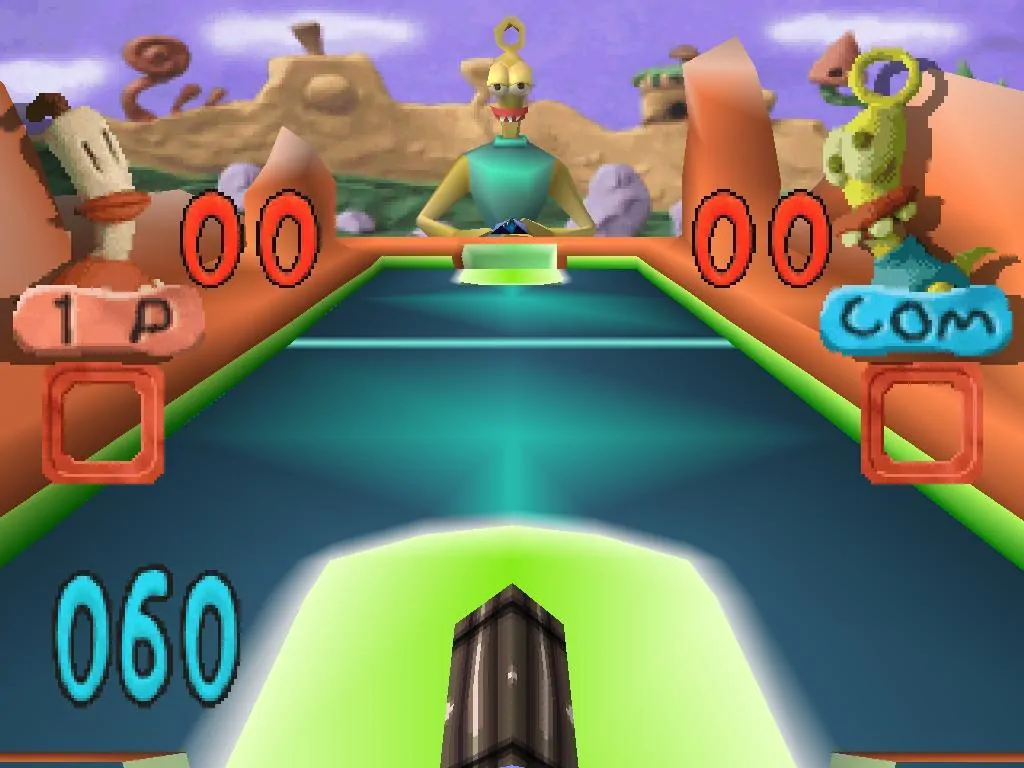
Finally, in 1999, the series' final game hit the PS1 - the oft forgotten Japan exclusive, Klaymen Gun Hockey; a spin-off title centered on, of all things, air hockey - a totally left-field choice of gameplay that has nothing to do with the previous two installments, thematically or otherwise. With no clay to speak of, no relevance to the series' continuing storyline, and none of the series' original staff involved, you'd be forgiven to omit this one from your Neverhood chronology; it's far more interesting for the fact it exists at all, than of any merit of it's own.

The Neverhood Chronicles sat dormant, having closed on the melancholic, vague ending of Skullmonkeys; Klaymen drifting into the endless void of black surrounding Idznak after defeating Klogg's gargantuan flying doomsday device, Evil Engine Number Nine - mindlessly snapping photos as he's pulled quietly into the abyss, quite literally never to be seen again. Bye, Klaymen.

However, it seemed the series might once again spring to life, as news of a Neverhood movie crept through the web...

Klaymen battles a monster


As early as 2007, production on "The Neverhood" began; it being one of three movie projects, including adaptations of Samurai Jack and The Seven Deadly Sins, intended to launch then-newly minted production company Frederator Films.

Neverhood series creator, Doug TenNapel, once again lead the project, approaching the film from a holistic perspective; opting to avoid a direct adaptation or follow-up to the 1996 point and click source material, while still including largely the same core characters, concepts and themes. In a now-deleted forum post, TenNapel mused, "I'm putting everything on the table story-wise and saying, 'What is the Neverhood about and who is Klaymen?' "

According to the initial press release, the film would have carried on the series tradition of stop-motion clay animation; this is supported by the photograph of Klaymen battling against an unnamed monster (possibly the Weasel) serving as the outline's cover, as well as a two photographs revealing the development of the models featured posted to the Neverhood Facebook.

An early twelve page outline was uploaded to Frederator Films' co-founder Fred Seibert's Scribd sometime around 2009, offering a glimpse into what the reimagined world of The Neverhood may have resembled; its logline reading as follows;

"A clay being must go on a quest to find a cure for his people who have turned into moronic animals."


Klaymen and Purpee
Klaymen, an inherently curious young boy, and Purpee, his easily-excitable dog, discover an abandoned Fish-O-Pod; an odd, four-legged vehicle, of which Klaymen had always wanted - but never been permitted - to drive. Accidentally powering it on, the duo take a brief joy-ride; inevitably crashing as it's steering wheel flies loose, slamming through a clay wall; a huge crack revealing a world hidden beyond the walls of their clay home, the Neverhood; an overgrown forest known as the Junglehood. The duo briefly explore the alien world, enjoying it's foreign flora and fauna including the burp-inducing Go-Go Fruit; sloppily hiding it's entrance beneath a layer of leaves and clay as they return home.

As per usual, the Neverhood itself - including the Junglehood - is an island of sorts, alone in a vast, empty expanse of black.

The Never and JungleHoods

Later that night, as Klaymen and Purpee read of the legendary Big Robot Bil, Klogg - an evil being from the Junglehood - peers through the crack connecting their worlds; sticking a harpooned device, the Moostifier, into the ground; hairy tentacles suddenly creeping through the NeverHood, transforming it's people into the rat-like Moosts; a hunched, hideous vermin common to the JungleHood. Discovering the herds of ravenous Moosts the following morning, Klaymen and Purpee venture into the Junglehood; certain to right their wrong. 

A Moost
Silent and empty, the Junglehood appears to have once been as populated as the Neverhood; it's clay buildings buried beneath foliage, as it is revealed it's people, too, were turned to Moosts. Soon, the duo encounter the Weasel; narrowly escaping as Willie, adim-witted Junglehood resident, and Hissy, his pet snake-cat, pulls them into the safety of their home.

Willie reveals that Klogg has turned countless Hoods into packs of Moosts; the all-powerful sculptor, Hoborg - his castle on the other end of the Junglehood - being their only hope. 

Temporarily taming the Weasel with the help of Willie, the cast venture to Hoborg's castle; encountering a broken, precarious bridge, soon further destroyed by the Weasel's unpredictable antics - halting their progress. 

Looking back wistfully on the world of the Junglehood, seemingly defeated, they notice the faint impressions of a man along it's underside - realizing it to be none other than the fabled Big Robot Bil, climbing down to activating the gigantic, mythical being. Big Robot Bil, thankful to once again be awakened, launches the group across the gap to Hoborg's castle.

Klogg

Inside, they discover Hoborg, too, has been transformed - now powerless against the devilish Klogg; sitting, crowned, atop Hoborg's throne. Klaymen manages to steal the Moostifier as the gang escape into Big Robot Bil, quickly returning the Jungle and Neverhoods to their former glory. 

Klogg, using his Robot Hecto Nine, follows closely behind; battling against Big Robot Bil before both machines plummet into the surrounding abyss, leaving Klogg behind as he ejects himself via large mechanical wings. Crash landing, Klogg fearfully threatens to turn the people back into Moosts - cornered by the enraged clay-people of both worlds - as Klaymen, alone, offers forgiveness; hoping Klogg would be willing to join their newly discovered family. 

Big Robot Bil and Robot Hecto Nine

Klogg reveals his heart is made not of clay, but stone - certain he'll never be able to join them. Klaymen, however, offers the power of Hoborg - knowing it will be able to save him; and, as Klogg lowers his defenses, his stone heart turns to clay; ending in a large, celebration as Hoborg, still in his castle, cures himself of Moostification - silently congratulating the faithful Klaymen.

As the party rages on, Willie, Klaymen and Klogg venture into the abyss in search of Big Robot Bil; flying off on Klogg's now repaired mechanical wings.


Willie
Though featuring most, if not quite all of the original Neverhood's core elements, the film greatly expanded on and added to the concept's setting and characters; most notably in the enhanced humanization of Klaymen, Willie, and further Neverhood geeks.

Once dissonant, silent, and perhaps even eerie, the film's Klaymen is talkative, adventurous, and youthful - aspects not entirely inaccurate to his original portrayal, but nevertheless, different. This sums up the majority of the film's changes to the original game's concepts. TenNapel seems to have heavily battled with and focused on the sense of visual engagement, as well as simplicity necessary for such an adaptation; particularly, one set to retell the story of a decidedly abstract game. In the words of the man himself, "Part of Neverhood's problem is that it's so unique. It almost CAN'T be a TV show or movie because it really is a gaming experience...  a lot of story elements came about because it was a game that would be weird in a movie."

Mock-up development

Frederator Films ultimately never released any features, including the three pictures intended to introduce the company. Needless to say, The Neverhood was dead in the water. Though most sources chalk up the Neverhood film's cancellation to budgetary reasons alone, TenNapel further explains as follows; "[The Neverhood Movie is] dead as far as I know. Or I should say that it never quite got off the ground... the heat came off of the project. We were talking to Lyca and Sony about a movie. Close but no cigar."

Aspects of the film's narrative lived on through the series' following installment, Return to The Neverhood; a self-described "musical novella" in which the lead characters, Clay-Guy and Mud-Gal, undergo a transformation of sorts after consuming a rather literal "forbidden fruit" - both, of course, reflecting the Biblical recount of Adam and Eve, carrying on the religious theming and imagery present in all Neverhood stories. The Neverhood spiritual successor, Armikrog, also carries on certain elements of the film; small aspects of Klaymen's revised design, such as his odd, noodly "hat", reappear in the analogous Tommynaut; with the general role and appearance of Klaymen's pet Purpee morphing into the outspoken canine sidekick Beak-Beak. Likewise, both characters are comparatively expressive against the original version of Klaymen, and even speak.


Am I a huge fan of this interpretation of The Neverhood? Not really. I've nothing against alternative takes on characters, storylines; I enjoy when a concept is able to experiment within a new vision. Still, I feel the appeal of the original Neverhood games and world was it's mysterious, and alien nature; both mainline games felt deeply personal and artistic, flying far above and beyond most video games in tone. This version of the Neverhood universe is simply too homogenized. Rather than the memorable impressionist vibes, or strange, exciting worlds of the titles preceding it, the film seems to have aimed for something less Dali, more Dreamworks. For every interesting new idea, five more have been, quite frankly, dumbed down. They certainly nailed what they were aiming for, I just can't say I'm too impressed by the target.

In this sense, I agree with Tennapel's sentiment that The Neverhood is not perfectly fit for the film medium; though the awesome in-game cutscenes are a highlight of the series, the manner in which a story and world can unfold is entirely different between the sometimes parallel mediums of games and movies. Perhaps this explains the series' transition to the page in the aforementioned following installment, Return to The Neverhood.

I plan to look further into the obscure and unspoken areas of The Neverhood Chronicles soon; from comics to concept albums, there's plenty to explore. We'll see, won't we. 'Till then!

Saturday, May 7, 2022

Review - Topps Sonic The Hedgehog Bubble Gum Container

So, I've got a bit of an obsession with this particular little figure. All my life, it's floated silently through the background - an omnipresence; perched atop the crooked shelves of flea markets, smoke-stained and rotten; buried through the depths of dollar bins, locked behind pounds of Disney paraphernalia; looming ominously from behind the counter of an overpriced, over-idolized retro gaming pop-up shop, daring you to purchase a horrifically garish one-up beanie. They seem to fade in and out of existence itself; some sort of holy object, beyond our mortal understanding. Spooky.

I'm talking, of course, about Topps' "Sonic the Hedgehog Bubble Gum Container(s)". Not much of a name.

There was this odd stretch of time from the 80's to the late 00's where pretty much every major video game character was barely represented in the world of action figures; and if they were, it was most likely overpriced to Hell and back, second-hand. Quite the contrast to today, where entire aisles are dedicated to the worlds of Nintendo, Sega, and so forth. To most kids - myself included - your Mario reeked of minimum wage, your Kirby had wheels, and your Bowser was that thing from TMNT 2.  Believe it or not, even during the Sonic series' peak years, there really wasn't much in terms of proper toys for the franchise. Sure, you've got some dolls, and if you were lucky, you might've even scored some cool region-locked goodies. But, besides that, the best you could do in terms of a widely available Sonic toy - this side of landfill fodder - was... well, really, this, which I think makes the figure all the more interesting as a memento of the era and character. 

How far we've come!

Perhaps that's why the vast majority of these figures you'll find in the wild appear to have survived a devastating crackhouse incident. 90's kids played rough.

These guys were sold "at most candy stores", to quote an advertisement seen in Sega Visions' 1993/1994 "Totally Sonic" merchandise section (pictured on the right); including, namely, stores such as BlockBuster and Video Tech. It seems there were two releases; first, in 1993, sold in a shelf display box containing individual figures, and second in 1994, available as a bagged two pack. Yin-Yang style. 

All figures read "©1993 SEGA" and sport a fashionable "GUM NET WT 0.4 OZ" sticker across their tummies. A generic bar code sticker is stuck beneath his soles, including copyright, safety and ingredient information. Boring. Inside their hollowed-out husks of skulls are a variety of yellow, pink and brown pebbles; these, presumably,  being bubble gum. As far as I know, no variations in the figures themselves seem to exist beyond the pictured prototype; with it's solid black and properly aligned pupils. Neat. I wonder if that still exists somewhere. 

My figure is of the perhaps more common bagged variety; coming fresh, and in-package, complete with candy. But don't worry; I've violently torn it open with all the care of a sugar-high toddler, just as God intended. Let's take a closer look at that wicked cool package design. 

Anyone who owned any Sonic merchandise of this era will almost certainly have a heart-wrenching, gut-spewing, ass-blasting nostalgia attack just seeing this time capsule of a zip-loc. Interestingly, I suffered these same effects upon ingesting the aforementioned bubble gum - but we'll get there. Between that warm shade of reddish-purple, that iconic Green Hill Zone checkerboard pattern, and the beautifully graphic style of illustration, this baggie's screaming "Genesis".
 
I really dig the logo, featuring a distinctly Japanese Sonic; notice the brighter color scheme and wider eyes. Not quite sure what's up with that double-chin, though - must've been a bad angle... or, in reality, some sort of layering issue. It's a bit more apparent on his misaligned half-chest. 

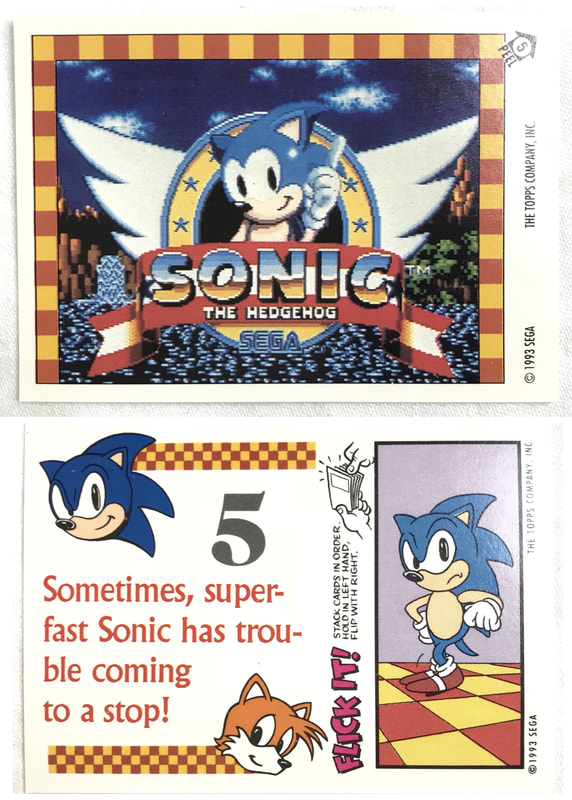
Unsurprisingly, this particular Sonic illustration is not totally unique to the figure. Topps used a variety of stock Sonic .pngs across their range of merchandise; while some, as generic as generic gets, others look practically traced from the game's original sprites; which leads us to this particular Sonic's origin. Take a look at this trading card - then, again, the bag's illustration.

That's right - for some reason, they not only made a card featuring frame six of the Sonic the Hedgehog's title screen, but also an alternate traced version that seems to have only been used here. How I managed to recognize this - let alone, why Topps chose to use that of all frames -  is beyond me. 
 
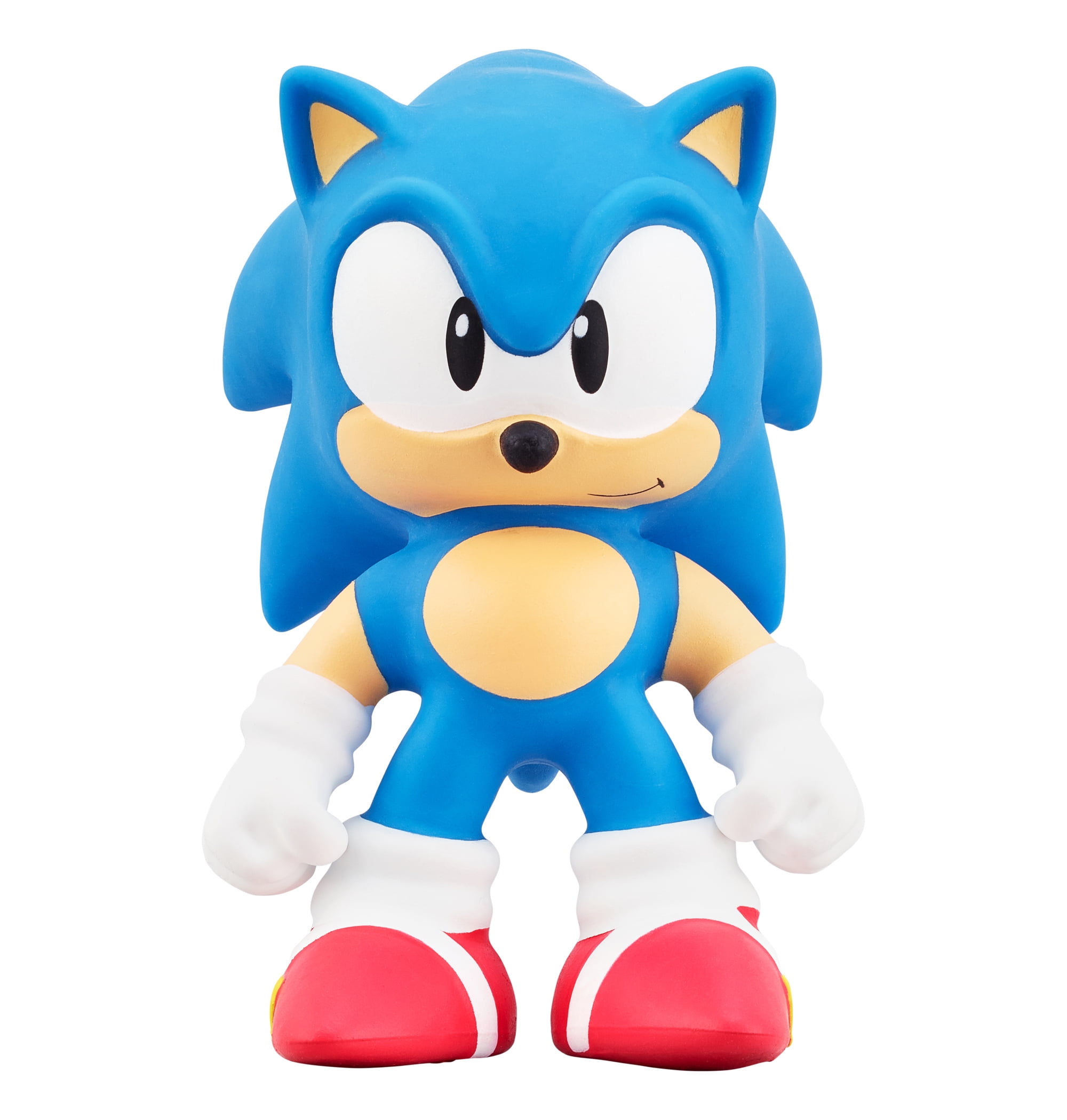
What I really love about this figure is how spot-on accurate it is to the Sonic I truly grew up with; Greg Martin's iconic Americanized design. This isn't the alleged "classic" design, with pastel blue fur and Mickey Mouse coke-bloat - and it ain't good ol' angular anime Sonic, either. It's sort of its own thing. He's lumpy, he's chubby, and he's a bit on the wonky side; and damn, is he cool. I genuinely think this is the only Sonic figure that so perfectly captures this specific likeness, right down to his flat mohawked sprawl of spines. It might be hard to notice due to the lack of definition in the sculpt's lower half - blame the budget - but even his bow legged, thin footed lean is accounted for! I may be coming off sarcastic, and it isn't flawless, but these are all elements of Martin's Sonic that I've truly come to love. It's clearly going for an art accurate approach, and I adore that in any figure.

Obviously certain liberties have been taken - Candy Sonic's got a sort of... alien-clown-baby-head going on... but eh, even Sonic himself couldn't stick to the style sheet during the early 90's - so, if anything, being off-model just adds to the authenticity. Funnily enough, the only major detail they've really missed is his teeny-tiny tail - but not out of laziness, or simply not knowing it exists. Take a closer look at the original illustration; his gigantic left fist is perfectly positioned to hide any tail at all. In a sense, once could say the figure's even more accurate thanks to this stunning attention to even the most minute of design elements. Truly incredible.

Onto the paint - or, more accurately, "color work". I think it suits the figure, and for a candy toy, its right at the standard - though, naturally, it's nothing groundbreaking. I feel like I have to keep making it clear that, man, these things probably ran for under five bucks. Let's not get too elitist about our children's food products. Save that for the SuperPlastic reviews.

Separate pieces of plastic fill out the majority of Sonic's red, white and blue palette. Unfortunately, this leads to sculpted details such as Sonic's ears and shoes going unpainted. Still, give them credit - they actually went out of their way to individually cast socks, gloves, and even a cute rubber nose. Considering each color is a completely separate piece, the added amount effort in construction is well appreciated. You get the feeling these figures genuinely were designed with some amount of care.

A dedicated  repaint of the figure would look really incredible; the sculpt's already leapt from the old Genesis clamshell - all you need is that, slimy, shiny, airbrushed Bugs Bunny look. 
 
Well, at least, that's the sort of mood you get when you've got two sparkly new models. As mentioned before, some of us aren't so lucky. That cute rubber nose? Constantly torn off. Eyes? Jaundiced. Hands? Lost. The shared-joint arms often present issues, as well. My oldest figure can't hold a pose, while the unopened one feels like it'll snap if I get too risky with the shoulder. Luckily, the Sonic I decided to completely unpackage has nice, solid joints that actually function; and, for what it's worth, the majority of others I've owned and encountered have been fine, as well. 

 
New, unopened, and post-flea market Sonics

Now, time for the heart of this review - the part you've all been waiting for - tonight's main course. The Taste Test. Let's dig in to - and I quote - "Sonic's own special bubble gum". Yikes!

In 1993, Sonic's gum-roofie-pebbles were a boring smack of yellow, pink, orange and brown. "Blast-based bubbles", yeah right. Now, in 2022 - after years of delicately monitored fermentation - we've got a supersonic variety of rare and delectable flavors! Choose between flesh chunk, petrified corn, chewed earplug, and - my favorite - necrotic infection! Don't get too excited - they all taste the same. Ever had one of those abhorrent Circus Peanut candies that look delicious, yet taste like a dementia diagnosis? I'd say that's about one-to-one exactly what these morsels of terror tasted like after decades of rotting away inside everyone's favorite Hedgehog. 

Topps' one and only Sonic figure really is a neat piece of merchandise; it captures an extremely specific, nostalgic take on the character, and, at the time, really filled the role of your go-to Sonic toy. Sure, he's not much more than a glorified statue, and sure, you could debate whether or not Martin's Sonic even looks good to begin with - but, to me, this figure's got it all. Maybe it's just because I tend to enjoy simplistic cheap-toys, or it could be that permanent rose-tinted vision implant, but I genuinely think this is an underrated little figure that's perfect for any classic Sonic fanboy. I should know. They pop up on eBay and the like fairly often, so much so that new old stock seems fairly easily available; all for pretty conservative prices, considering how over-blown retro gaming merchandise tends to become.

Just... don't bother with the candy. Excuse me, I'm on my way to "Stomach Pump Zone".